Add your promotional text...

Your blog post
Blog post description.
1/7/20264 min read


My post contentYears ago, Heinz ketchup launched a successful, decade-long ad campaign touted comparative product quality, using thickness . Heinz proven by its comparative thick viscosity Vs. competition. The campaign included close-in shots of ketchup being dispensed at a dramatic, glacier like speed to accentuate the product’s thick formula. The spot, link below was a popular spot that made use of Carly Simon’s song Anticipation.
https://www.youtube.com/watch?v=0IobpIKshr8&pp=ygUSaGVpbnogYW50aWNpcGF0aW9u
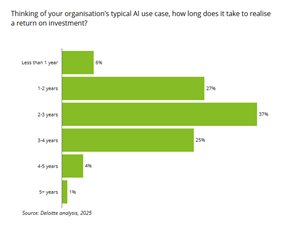
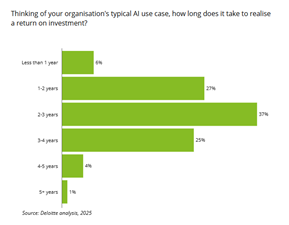
While reading the findings from a recent Deloitte study (10/22/2025) on AI financial return to-date, I was struck by the Heinz analogy. The financial returns on the historic levels of investment in AI is showing similarities to Heinz ketchup, it’s slow pouring. Deloitte recently released (10/22/25) results from a recent AI survey conducted among roughly 2k global business leaders. The results paint a picture AI results to-date.
Payback is sluggish, lagging prior tech. implementations (norm = 7-12 mos.).
· Respondents reported that only 6% of AI initiatives break even in 12 months.
· By year 3, the # of initiatives reaching breakeven had only increased to 37%.
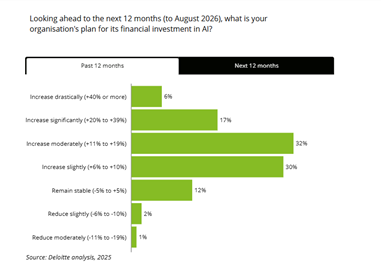
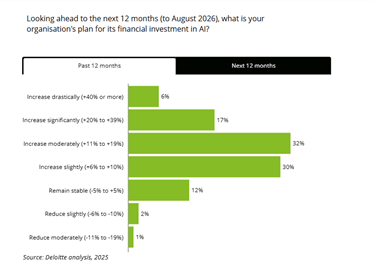
Counter-intuitively, 91% of companies plan to increase AI budgets next year.
What’s driving/dragging the pace of implementation to-date?
1. Lack of readiness – Many companies overestimated their system/data readiness. One in four companies cite siloed systems and data quality as obstacles. AI doesn’t compute work-arounds.
2. Ai is a technology but NOT a technology initiative - The potential of ai is in it’s application. Ai is at it’s core a business process initiative, capable of simplifying existing process. Success requires a change management approach Vs. technology implementation.
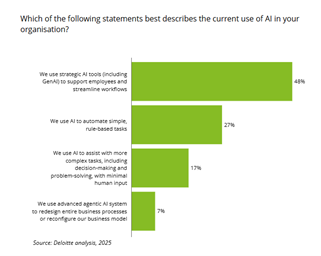
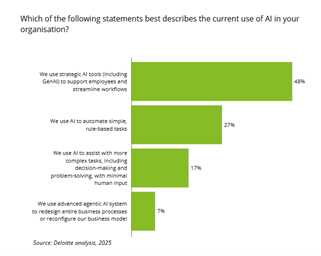
3. Lack of a long-term vision - Most firms are currently unable to articulate how AI either enhances or drives long-term strategy. Instead, the focus is on individual adoption to assist with existing work.
Why are companies continuing to increase investment?
1. Potential - Ai has been hyped to a degree not seen since the internet. Futurists have been describing scenarios where an enterprise runs with just a few humans and many ai agents and every home has a robot butler/assistant. Generative ai has built the foundation, and trust that some of these capabilities are evolving into near-term realities. Innovations such as self-driving cars in fact already in road tests.
2. FOMO - Famously, a former IBM executive once said “I think there’s a world market for maybe 5 computers”. Failure to accept a
3. nd integrate new technologies (that add true value) can be a death sentence. Blockbuster, Kodak and most recently Rite Aid, didn’t recognize the degree to which technology would impact their legacy business model. Today’s CEOs are clearly motivated to some degree by the fear of missing out.
· What steps can be taken to improve adoption and ROI?
Adoption individually has been historically broad-based and fast. More than 50% of employees regularly us LLMs as a tool to help them produce improved results in less time.
a. Make data everyone’s job - Most organizations tend to overestimate their ai data readiness. To-date, they have been able to patch together multiple data sources and creating work-arounds for legacy systems. To deliver consistent quality of output, ai requires data accuracy, quality and uniformity. The importance of the data sets can’t be overstated. To validate the data and processes, the people closest to the work offer the best resource. Existing cross-functional teams, tasked with executing within the current system know the “work-arounds” and also what’s right for the business. Each team also requires resourcing from the data team.
b. Document current process flows – Internal processes (ex. Invoice payment) are usually informal and include undocumented steps or work-arounds. These hidden requirements are critical to unearth for to insure success in the next step.
c. Process simplification - Teams to identify parts of the existing process for areas where ai can offer obvious (low risk) steps where LLM capabilities can plug-in. An example would be ai generating new hire paperwork, benefits info., technology orders, on-boarding requirements, supervisor touch-base scheduling, etc. all upon offer-letter acceptance.
d. Process optimization – Process optimization is when a team of bots are able to automate most/all steps inside the process. Building on the previous example; ai handles all activities involving company/employee information exchange. After orientation, bots would execute benefit communication, annual reviews up to and including the return of company assets and other separation needs at employment termination.
Clearly if in 12 months-time, significant returns remain elusive, we will have issues. We recommend companies double-down on driving AI to drive process simplification to yield results. Process simplification is transparent, while offering fastest and lowest risk potential. They’re inclusive, low-cost and will build AI credibility within the organization. Remember AI is NOT a tech implementation…


Accelr8
Management Consulting
Add fuel, reduce drag...Accelr8
Fuel your business. Get our Blog!
© 2025. All rights reserved.
iwanttogofast@accelr8iq.com